Call: 216-533-2343 Email: info@sorbster.com
Back to Sorbster Blog Page > New Resource: Sorbster’s Product Line Card for Heavy Metals & Contaminants Removal
New Resource: Sorbster’s Product Line Card for Heavy Metals & Contaminants Removal
April 2026
When you are evaluating treatment media, you usually need answers fast.
What contaminants can this media remove? Which product is the right fit for the water chemistry you are dealing with? What is happening at the chemical level that makes the treatment work?
Those are the questions we had in mind when we created Sorbster’s new Heavy Metals & Contaminants Removal Product Line Card.
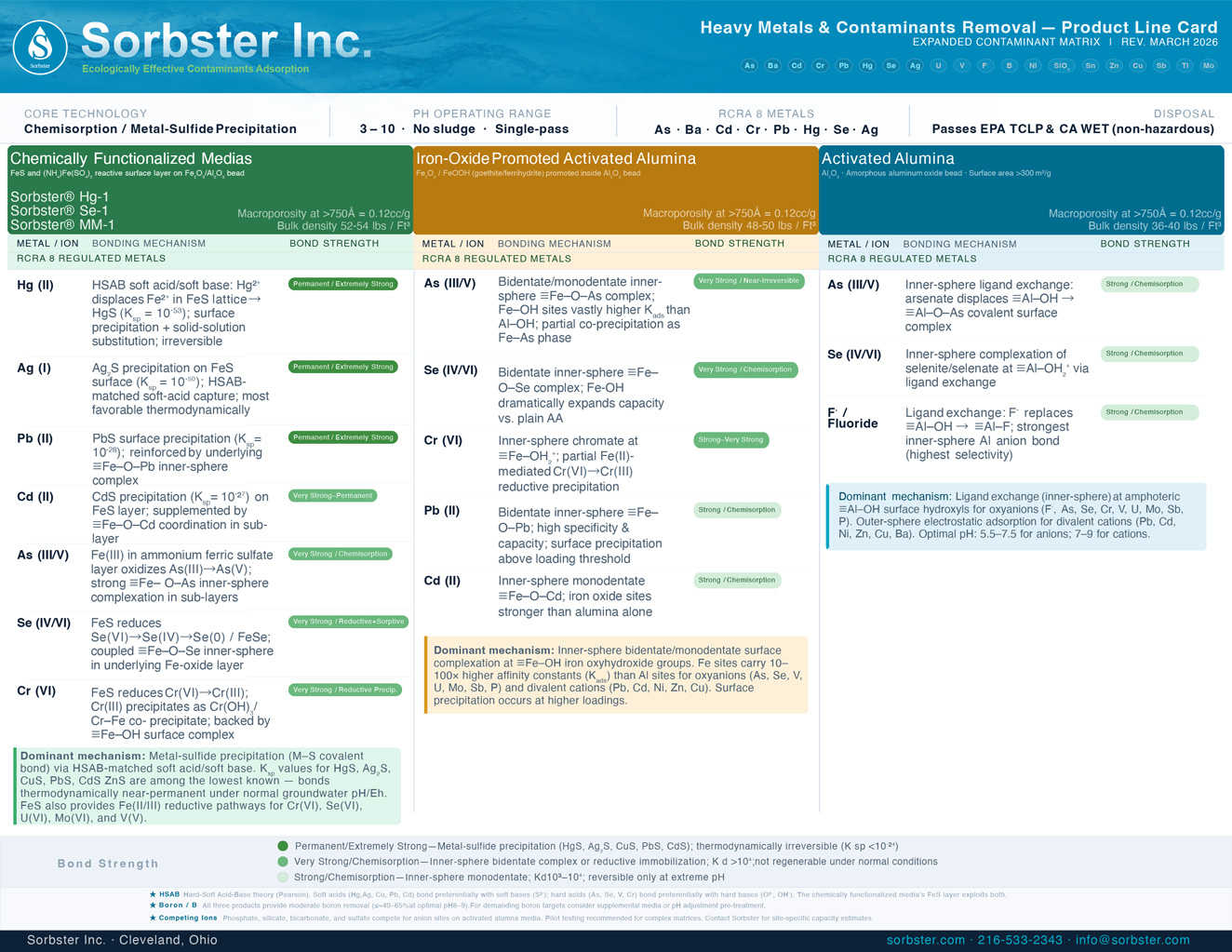
This new resource brings our portfolio together in one place and gives a side-by-side view of our three major product lines: Activated Alumina, Iron-Oxide Promoted Activated Alumina, and Chemically Functionalized Media. It is designed to make it easier to see which contaminants each product line addresses, including both RCRA 8 metals and other priority contaminants, while also giving a straightforward explanation of the bonding chemistry behind each one.
At a glance, the Line Card shows the breadth of contaminants Sorbster technologies can address, including arsenic, barium, cadmium, chromium, lead, mercury, selenium, silver, uranium, vanadium, fluoride, nickel, tin, zinc, copper, antimony, thallium, molybdenum, and more. It also helps explain why different media families perform differently by outlining bond strength, from strong chemisorption to near-permanent metal-sulfide adsorption. That kind of context can be especially helpful when you are trying to determine which treatment approach makes the most sense for a specific application.
Each of the three product families plays a different role.
Activated Alumina is a high-surface-area aluminum oxide bead that is especially useful for contaminants removed through ligand exchange and surface hydroxyl chemistry. In practical terms, it is a strong option when ionic removal is a key goal, including contaminants such as arsenic, selenium, fluoride, uranium, vanadium, and phosphate.
Iron-Oxide Promoted Activated Alumina builds on that same alumina foundation by adding iron oxide functionality inside the bead. Those iron sites create stronger attraction for a wider range of contaminants, including arsenic, selenium, chromium, lead, cadmium, uranium, vanadium, fluoride, nickel, zinc, copper, antimony, and molybdenum. For treatment challenges that call for more selectivity or greater capacity than standard activated alumina can provide, this product line can offer an important advantage.
Chemically Functionalized Media represents the most specialized chemistry in the Sorbster portfolio. This family includes Sorbster® Hg-1, Sorbster® Se-1, and Sorbster® MM-1 and uses a reactive surface layer designed to support metal-sulfide adsorption, redox reactions, and strong inner-sphere bonding. That makes it especially relevant for contaminants such as mercury, silver, lead, cadmium, arsenic, selenium, chromium, copper, uranium, zinc, nickel, molybdenum, antimony, thallium, and tin.
For those already familiar with Sorbster, the Line Card also helps connect the dots between our product pages and real-world treatment discussions. Our broader platform is built around functionalized, enriched alumina media designed to bond with soluble metals and other trace contaminants at active sites. Depending on the application, that can support both broad multi-metal treatment and targeted removal tuned for specific elements. It also reflects the practical advantages many customers care about most, such as single-pass removal, simplified operation, and the potential for non-hazardous disposal when spent media passes TCLP.
That broader context is important. On the Sorbster website, products like Hg-1 and MM-1 are presented as targeted solutions for wastewater and other water treatment applications. Hg-1 is designed for soluble ionic mercury removal, while MM-1 is capable of addressing multiple contaminants at the same time, including arsenic, selenium, zinc, boron, mercury, and hexavalent chromium.
What the new Line Card does is make all of this easier to understand in one place. Rather than asking people to piece the story together across multiple product pages, it offers one clear technical snapshot of the Sorbster platform: what each media family is designed to do, which contaminants it can address, and what chemistry is driving performance.
That can be especially useful in the early stages of evaluation, pilot planning, or treatment-train design, when teams need something concise, technical, and practical before moving into site-specific testing. The Line Card also calls out important real-world considerations, including competing ions, boron performance, and the value of pilot testing in more complex water matrices.
If you are evaluating media for heavy metals or other priority contaminants, Sorbster’s new Line Card was created to help you get to the right questions and the right options faster, with more confidence.
Sorbster Inc. © 2026
All rights reserved.
Cleveland, Ohio
216-533-2343
info@sorbster.com
Sorbster Water Treatment © 2026
All rights reserved.
Cleveland, Ohio | Phone: 216-533-2343 | info@sorbster.com

Made In the USA
Terms and Conditions | Site Powered by Teknabyte