Call: 216-533-2343 Email: info@sorbster.com
Back to Sorbster Blog Page > When Mercury Limits Tighten: Planning for the Final Stage of Treatment
When Mercury Limits Tighten: Planning for the Final Stage of Treatment
March 2026
Most treatment systems are designed to remove the majority of contamination early in the process.
Solids are settled. Particles are filtered. Many dissolved metals are reduced along the way. For years, that level of treatment satisfied most discharge permits.
Stricter mercury limits change the design challenge.
When discharge thresholds fall into the parts-per-trillion range, the remaining concentration becomes extremely small. At that scale, small changes in chemistry, flow rate, or loading can influence performance. A system that performs well under average conditions may struggle to deliver consistent results over time.
For developers managing dewatering, remediation, or redevelopment projects, that final stage of treatment carries real risk. A missed discharge limit can interrupt pumping, delay construction schedules, and increase operating costs.
Designing the polishing stage of treatment requires understanding how common technologies perform when limits become extremely tight.
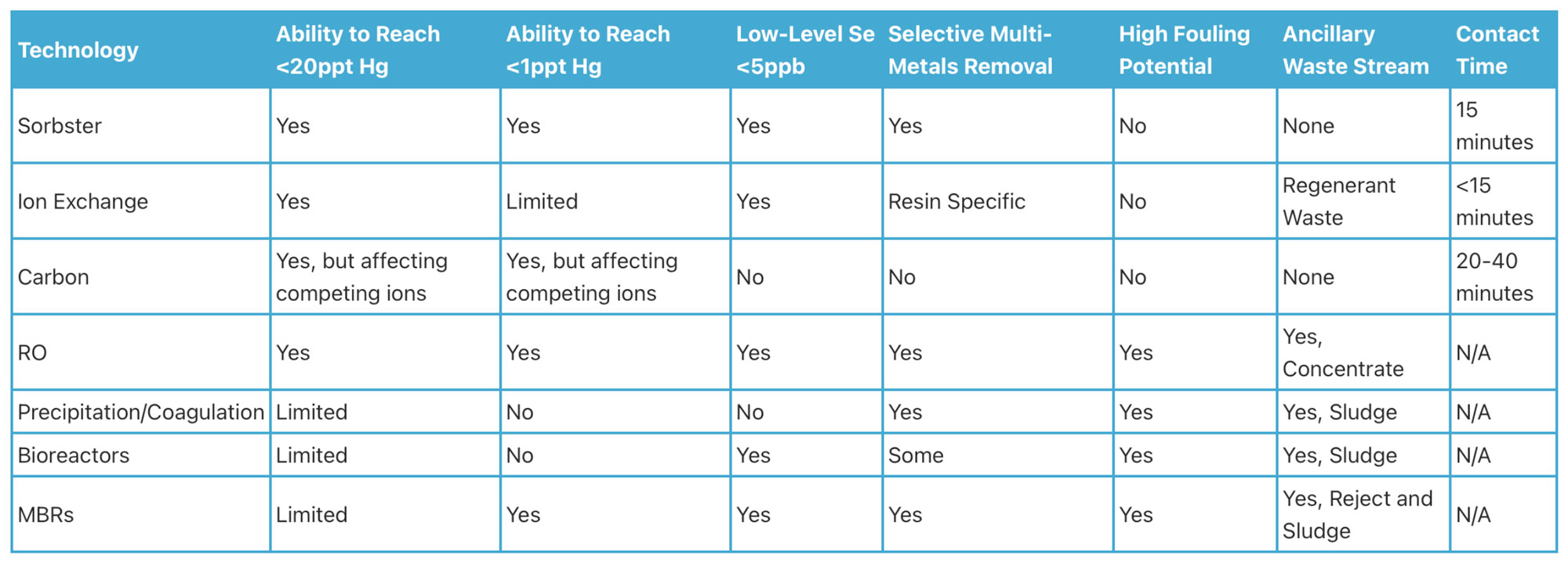
| Technology | Ability to Reach <20ppt Hg | Ability to Reach <1ppt Hg | Low-Level Se <5ppb | Selective Multi-Metals Removal | High Fouling Potential | Ancillary Waste Stream | Contact Time |
|---|---|---|---|---|---|---|---|
| Sorbster | Yes | Yes | Yes | Yes | No | None | 15 minutes |
| Ion Exchange | Yes | Limited | Yes | Resin Specific | No | Regenerant Waste | <15 minutes |
| Carbon | Yes, but affecting competing ions | Yes, but affecting competing ions | No | No | No | None | 20-40 minutes |
| RO | Yes | Yes | Yes | Yes | Yes | Yes, Concentrate | N/A |
| Precipitation/Coagulation | Limited | No | No | Yes | Yes | Yes, Sludge | N/A |
| Bioreactors | Limited | No | Yes | Some | Yes | Yes, Sludge | N/A |
| MBRs | Limited | Yes | Yes | Yes | Yes | Yes, Reject and Sludge | N/A |
The Final Stage Is a Design Decision
Utilizing common upstream processes, coagulation binds suspended material, clarification and filtration remove solids, pH adjustments drive the precipitation of many metals, and carbon reduces dissolved contaminants across a broad spectrum.
After these steps, trace levels of certain metals can remain. Mercury often persists in dissolved form even when other metals have been significantly reduced. That remaining fraction becomes the compliance risk that could tilt the balance of your project against your permit.
Polishing systems are installed at the back-end to capture those residual dissolved ions. This stage requires careful planning. It must be sized for peak flow, not average flow. It must account for real influent variability. It must include realistic safety margins. If polishing is undersized, breakthrough can occur earlier than expected. A single failed discharge sample can halt pumping and delay construction. Mobilized crews, equipment rentals, and contractor schedules continue to accrue costs during shutdowns.
Developers benefit from treating polishing as a core design element rather than a secondary addition.
How Conventional Treatment Technologies Perform
Several established technologies are commonly used to remove dissolved metals from water. Each plays an important role in treatment systems. Their performance characteristics become more important when mercury limits approach parts per trillion.
Carbon Adsorption
Granular activated carbon is widely used because it adsorbs a broad range of contaminants and integrates easily into many treatment trains.
Carbon performs well as a middle stage of treatment. It often reduces mercury concentrations significantly. Performance depends heavily on water chemistry. Competing ions, organic material, and pH conditions influence how strongly mercury binds to the carbon surface.
At very low concentration limits, those variables can affect consistency. Carbon beds can perform well for extended periods and then experience faster breakthrough when chemistry changes. Groundwater remediation projects frequently encounter these shifts as pumping expands the capture radius and draws water from different areas of the aquifer. For this reason, carbon is often followed by a targeted polishing stage that ensures final compliance.
Ion Exchange
Ion exchange resins capture dissolved metals by exchanging ions between the resin surface and the water passing through the system. Ion exchange can achieve low effluent concentrations when the resin chemistry matches the contaminant profile. Performance depends on proper resin selection and on the presence of competing ions in the water.
Resins eventually require regeneration. During regeneration, the captured contaminants are removed from the media and concentrated into a secondary waste stream. That waste stream must be transported and managed according to regulatory requirements.
For some installations, this process works well. In temporary treatment systems or construction-driven projects, the additional handling and logistics can add operational complexity.
Reverse Osmosis and Membrane Systems
Reverse osmosis and other membrane systems remove dissolved contaminants through physical separation. Water passes through a membrane under pressure while contaminants remain on the reject side.
These systems can achieve extremely low effluent concentrations. They also require careful pretreatment to reduce fouling and scaling. Membranes must be cleaned periodically and eventually replaced. Membrane systems produce a concentrate stream containing the rejected contaminants. That stream must be handled and disposed.
In permanent facilities with dedicated operators, membranes can function effectively. In temporary dewatering or redevelopment environments, their operational demands can require additional planning.
Precipitation and Biological Systems
Precipitation processes and biological systems remove metals through chemical reactions or microbial activity. These approaches are highly effective at removing bulk contaminant loads. They are commonly used in earlier stages of treatment trains where large quantities of contaminants must be removed efficiently.
At ultra-low concentration limits, trace amounts of dissolved metals can remain after precipitation steps are complete. Biological systems also generate sludge that must be managed as part of the treatment process.
These technologies continue to play an important role in treatment systems. Additional polishing steps are often required when permits demand extremely low discharge levels.
Design Considerations for Ultra-Low Mercury Removal
Once mercury limits move into the parts-per-trillion range, several design considerations become central to system performance. These considerations shape the selection of polishing technology and influence how reliably a system performs under real field conditions.
Consistent Performance at Trace Concentrations
At very low concentrations, treatment systems must capture extremely small amounts of dissolved metals on a consistent basis.
Targeted polishing media are designed to chemically bind specific metals. The metal ion forms a strong chemical bond with the media surface. This type of binding provides stable capture of trace contaminants and reduces variability in performance.
Strong chemical binding supports consistent removal even when water chemistry changes during the course of a project.
Sorbster® media are designed around this principle. The media form a strong chemical bond with dissolved metals such as mercury and selenium, allowing the polishing stage
to capture trace concentrations reliably after upstream treatment has removed the bulk of contaminants.
Managing Waste Streams
Many treatment technologies create secondary waste streams during operation.
Regeneration processes concentrate contaminants into a separate liquid waste. Membrane systems generate concentrate streams. Precipitation processes produce sludge that must be dewatered and disposed of.
Waste streams require transportation, documentation, and disposal planning.
Some polishing media bind contaminants permanently and eliminate regeneration cycles. Used media can be tested and disposed of according to established landfill acceptance criteria. Reducing the number of waste streams simplifies logistics and helps developers plan disposal pathways in advance.
Sorbster® media bind metals directly to the surface of the media rather than removing them during regeneration. This approach eliminates regenerant waste streams and allows the spent media to be disposed of according to standard leach testing requirements.
Operational Simplicity
Construction-driven treatment projects often operate under tight schedules. Equipment must function reliably with limited maintenance and minimal downtime. Technologies that require frequent cleaning cycles, specialized operators, or complex pretreatment steps can introduce additional operational risk.
Systems designed around straightforward flow-through polishing stages can reduce maintenance requirements and simplify field operations. Sorbster® systems operate as a flow-through polishing step following conventional treatment processes. The media require no regeneration and minimal operator intervention once installed, which helps maintain steady operation throughout a project.
Contact Time and Equipment Footprint
Every polishing technology requires sufficient contact time between water and treatment media. Longer contact times require larger vessels or multiple treatment units. Equipment footprint becomes an important consideration on sites with limited space. Containerized treatment systems and urban redevelopment projects often face layout constraints.
Technologies that achieve effective removal within shorter contact times can reduce equipment size and simplify installation. Sorbster® media are designed to achieve effective removal within relatively short contact times, which allows developers to incorporate polishing vessels without significantly expanding system footprint.
Disposal Certainty
Disposal requirements influence both cost and project scheduling.
Spent treatment media must meet regulatory standards for landfill disposal. Testing protocols evaluate whether contaminants could leach from the material over time. Treatment media designed to bind metals strongly are more likely to meet these requirements. Confirming disposal pathways before startup provides developers with greater certainty at the end of the project.
Sorbster® media form strong chemical bonds with captured metals, allowing the spent media to pass standard leach testing protocols such as TCLP. This provides developers with a clear disposal pathway once the media reaches capacity.
Designing for Confidence
Ultra-low mercury limits are achievable with current technology. Achieving them consistently requires thoughtful design.
Developers should evaluate:
• Removal reliability under variable conditions
• Disposal clarity before mobilization
• Operational complexity and staffing requirements
• Hydraulic sizing based on peak flow
• Analytical alignment with permit limits
Compliance at parts per trillion requires precision across engineering, operations, and testing. A polishing system like Sorbster® media should deliver steady performance under real-world conditions. Clear planning at the outset supports schedule protection and financial predictability.

Sorbster Inc. © 2026
All rights reserved.
Cleveland, Ohio
216-533-2343
info@sorbster.com
Sorbster Water Treatment © 2026
All rights reserved.
Cleveland, Ohio | Phone: 216-533-2343 | info@sorbster.com

Made In the USA
Terms and Conditions | Site Powered by Teknabyte